
30 credits. From unmet clinical need to viable business opportunity with a manufacturable device.
Four cornerstone courses across three terms, BME 501 through 504, anchor the year. Supporting technical and entrepreneurship coursework rounds out the full product-development continuum, which is the part that separates this from a senior design program: every device here is also a business case.
Three terms. One company. End to end.
Needs Discovery
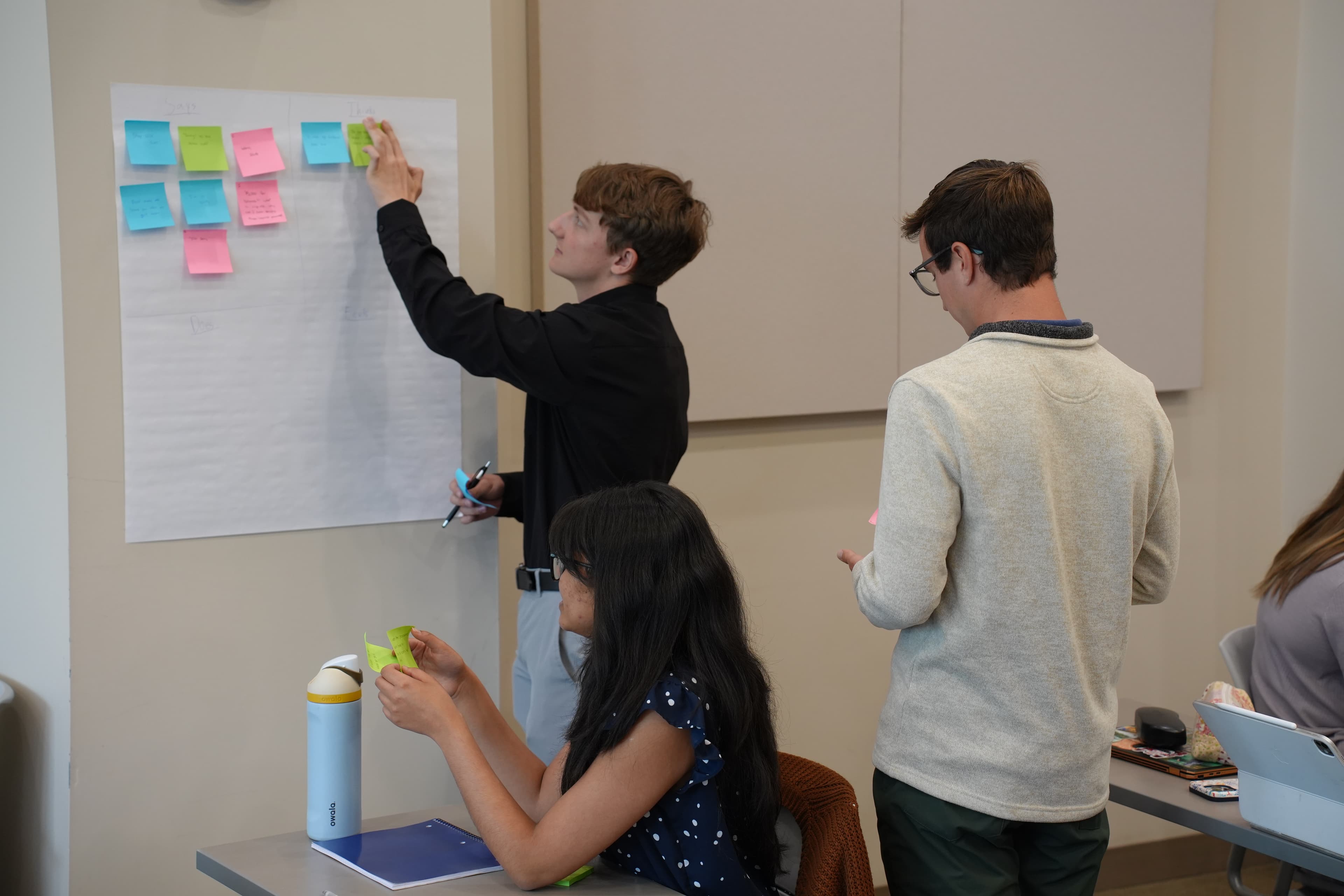
Practical tools for front-end healthcare innovation through clinical observation, stakeholder interviews and secondary research. Students build competence in ethnographic research, value-proposition design, and communicating with healthcare stakeholders.
- Ethnographic clinical research
- Stakeholder interviews
- Value-proposition design
- Healthcare market dynamics
Design & Innovation
Translate user needs into functional requirements. Reduce technical and business risk through structured experiments. Build minimum viable prototypes. Includes guest lectures and site visits covering IP, usability and funding.
- Functional requirements
- Risk-reduction experiments
- MVP prototyping
- IP, usability, funding
Medical Device Materials & Manufacturing
Develop an arterial introducer system from material selection to a sterile, labeled, packaged product, designing, building and validating every component and every process on the way. Catheter reflow, injection-mold tooling, thermoformed trays, Tyvek pouch sealing. It is the pencil problem applied to a medical device: how to build something from scratch, using all of our equipment.
- Material selection
- Catheter reflow and tipping
- Injection-mold tooling
- Thermoform, seal and label
Product Development
What it takes to carry a prototype through market approval and into post-market surveillance: risk management, design for manufacturing, verification and validation planning, and fundraising against business milestones. No team finishes that journey inside one spring. Students leave knowing the time, the money and the evidence it demands, having moved their own device along it.
- Risk management
- Design for manufacturing
- V&V planning
- Milestone-based fundraising
A lecture course on the quality systems used to meet regulatory requirements for developing, testing, manufacturing and selling medical products in the global marketplace. General grounding for anyone entering the medical products field, and direct preparation for a career in regulatory affairs or quality assurance at a device, pharmaceutical or biomanufacturing company. Requires graduate standing.
At least three credit hours, sitting inside the eighteen BME hours and chosen with your advisor at either university. A for-credit internship is eligible, and most students use the hours to go deeper on whatever their own device turns out to need.
Three MBA or entrepreneurship courses taken at either UNC or NC State:
- TEC I & IIMBA/MSE 576 & 577NC State
- Start the StartupGRAD 718UNC
- Technology Commercialization FundamentalsGRAD 755UNC
“From manufacturing and prototyping to interdisciplinary teams and commercialization, the entire product life cycle is demonstrated through coursework and projects.”