
Sep 29, 2026 · 1 min read
Practical, Real-World Manufacturing for MedTech
BME 504 is the "pencil" problem for MedTech students - they learn to make a finished, packaged, and labeled medical device starting from scratch.
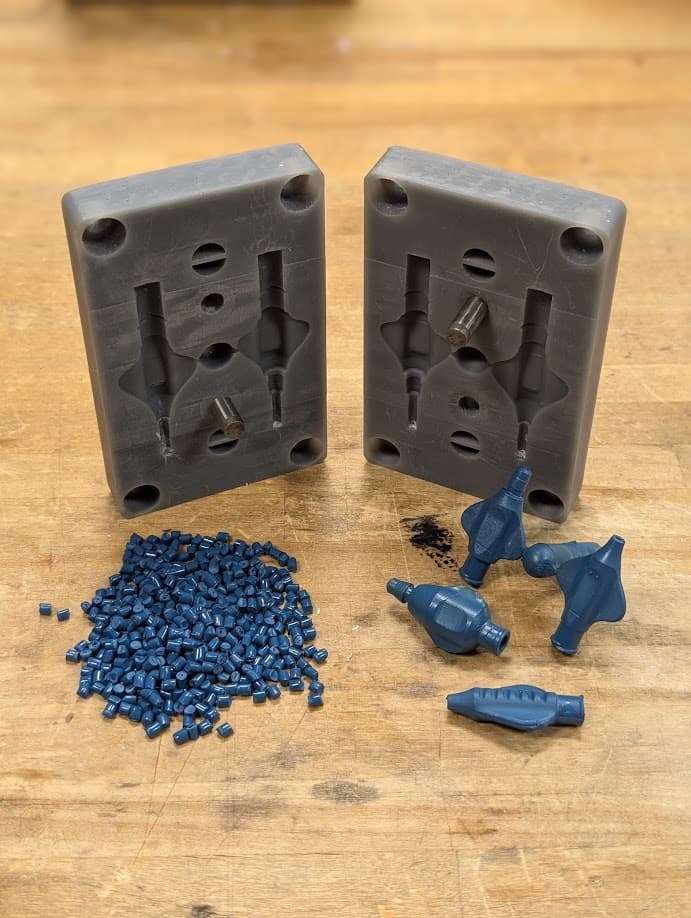
Additive Manufacturing, otherwise known as 3D printing, has exploded over the last several decades. Professionals and college students leverage these quick-turn technologies, including stereolithography, selective laser sintering, and fused deposition modeling, to rapidly produce components for products and fixtures. However, despite advances in materials, processing, and post-processing, additive manufacturing hasn’t replaced some of the more traditional manufacturing techniques for medical devices, and students who don’t learn to design for these techniques are often starting from scratch when they get an industry job after graduation.
Our BME 504 course teaches students to leverage 3D printing while designing for injection molding, catheter reflow, thermoforming, and related assembly techniques. In one module, students learn from experts on how to design injection-molded parts and tools, including considerations for sprues, runners, gates, core pins, and ejector pins. Following tool fabrication, students execute Design of Experiment studies to identify mold processing windows and optimize molding time with dimensional and aesthetic outputs.
The freedom to design your own injection-molded parts can lead to really creative ideas, along with some predictable failures! This Fall, we’ve seen everything from non-uniform walls causing sinks to short shots and unfilled features from mistakes in core pin to cavity alignment. Each “mistake” is a real-life, low-risk learning experience in this course.